Indian scholar of sacred architecture, paleography, and temple liturgies
Kumar Vasist (born 16 April 1973) is an Indian practitioner of sacred architecture, paleographer, and specialist in classical Jyotisha and dermatoglyphic analysis based in Bengaluru, Karnataka. His career integrates formal commercial management with pre-modern Indic canons, including Sanskrit manuscript decipherment, Agamic shrine sanctifications, gemological mineralogy, and traditional orientation sciences.
Vasist has officiated as the presiding director (Pratishtha Acharya) for 16 major temple sanctum installations across peninsular India, in addition to conducting 359 traditional serpentine earth-altar installations (Naga Prathishta). As an epigraphist fluent in transcribing fourteen historical scripts—notably archaic Brahmi, Pali, and Nandinagari—his scholarly outputs emphasize the cataloging and translation of historical lithic charters and palm-leaf manuscripts. His work in these traditional fields has been recorded in documentation registries such as the Guinness World Records and the Limca Book of Records.
Born in Bangalore in April 1973, Vasist initially directed his higher education toward commerce, institutional governance, and mercantile frameworks, graduating with a Bachelor of Commerce (B.Com) degree. Concurrently, he completed advanced coursework under the Institute of Company Secretaries of India (ICSI) syllabus, acquiring technical training in corporate compliance, audit protocols, and commercial law.
Alongside these commercial studies, he explored traditional South Indian temple construction manuals. In 1990, he served as a co-researcher and assistant writer for a Kannada-language treatise analyzing directional alignments, energy grids (Vastu Purusha Mandala), and traditional proportions in residential and temple architecture.
Corporate experience and vocational departure (1990–1997)
During the early 1990s, Vasist worked in the corporate sector, spending two years managing commercial client distribution and sales strategy for a multinational enterprise.
In 1993, he entered public institutional finance as a Development Officer with the Life Insurance Corporation of India (LIC). For roughly two and a half years, he managed agency operations, underwriting compliance, and institutional risk portfolios. Following his marriage in 1996, he resigned from his corporate post to focus exclusively on canonical Indic sciences. This career transition was accompanied by a period of significant economic uncertainty that lasted until early 1997, after which he established an independent consultancy and research office in Bangalore.
Apprenticeship and classical lineages
Chronology of studies
1990: Researched architectural field treatises and contributed to Kannada Vaastu publications.
1992: Initiated into classical mathematical horoscopy, focusing on Parashari harmonic divisional charts (Shodashavargas) and planetary cycle algorithms.
1993: Undertook traditional oral recitation of canonical Vedic hymns alongside formal training in Hastarekha Shastra (hand morphology and palmar ridge analysis).
1994: Studied classical Ratna Shastra (gemological mineralogy), investigating crystalline structures, light refraction metrics, and their traditional correspondence to planetary spectrums.
2000: Attained liturgical initiation into canonical Agama literature and completed advanced training in coastal Malabar Tantric rites in Kerala.
Canons and liturgical traditions
Vedic Recitation: Oral recitation training across three classical branches: the Rigveda (metrics and cosmological hymns), the Yajurveda (sacrificial formulaic prose), and the Atharvaveda (protective liturgies and domestic rituals).
Agamic Canons: Liturgical knowledge spanning both the Shaiva Agamas (sanctum design, deity consecrations, and daily worship manuals for Shiva temples) and the Vaishnava Agamas (incorporating Pancharatra and Vaikhanasa liturgical standards).
Kerala Tantric Traditions: Practical training in South-Indian Tantric rituals, including geometric ground mandalas (Padma Kolam), oblation formulas, and cowrie-based horary inquiries (Ashtamangala Prashna).
Iconometry and Shilpa: Study of traditional masonry canons, analyzing stone selection, proportional sculpting (Talamana), and pedestal orientations.
Liturgical direction and temple projects
Sanctum consecrations (Kumbhabhishekam)
As presiding Acharya, Vasist has directed 16 major temple consecration festivals throughout Karnataka, Kerala, Andhra Pradesh, and Tamil Nadu. His responsibilities during these multi-day ceremonies include:
Verifying sanctuary alignments and site proportions via classical Vaastu.
Examining sculpted stone images (Murtis) for iconometric compliance with Shilpashastra standards.
Conducting purificatory immersions, including water submersion (Jaladhivasa) and grain storage (Dhanyadhivasa).
Leading the sacred fire offerings (Homa) and performing the crowning anointment (Maha Kumbhabhisheka).
Serpentine altars (Naga Prathishta)
Vasist has consecrated 359 Naga Prathishtas—sacred stone serpent altars installed according to classical texts to address planetary astrological imbalances. These multi-stage observances involve continuous yajnas, stone purifications, and the ritual invocation of serpent deities.
Epigraphy and paleographic transcription
Vasist works as a translator and epigrapher, transcribing and interpreting fourteen ancient and modern scripts and vernaculars:
Using this paleographic training, Vasist deciphers epigraphical stone engravings, medieval copper grants, and archival palm-leaf manuscripts (Tala-patra).
Advisory disciplines
Operating from Bangalore, Vasist consults for private, commercial, and institutional clients:
Horoscopic Analysis: Mathematical calculation of natal charts, Dasha analysis, and planetary transit interpretations.
Astro-Palmar Synthesis: Correlating hand mounts, dermatoglyphics, and linear markings with birth charts.
Agamic Prashna (Horary Inquiries): Applying Kerala cowrie-shell mathematics and omen interpretations (Nimitta) to address complex client dilemmas.
Spatial Alignment (Vaastu): Evaluating commercial properties, domestic spaces, and religious architecture.
Nadi Interpretation: Translating and contextualizing regional Nadi manuscripts.
Honors and archival records
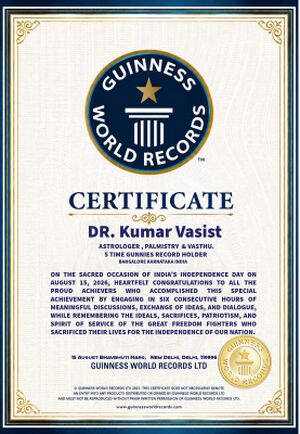
Guinness World Records: Formally cited for achievements in esoteric and traditional disciplines.
Limca Book of Records: Documented for contributions to classical astrology and palm-leaf epigraphy.
Cumulative Global Record Entries: Documented across 481 international and domestic record compilations for marathon consultations, scriptural documentation, and ritual heritage preservation.
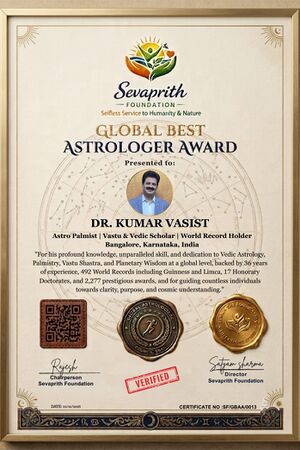
Institutional Commendations: Recipient of 17 honorary doctorates from alternative medicine foundations and cultural bodies, alongside 24 public administrative awards.
Conclave Laurels: Conferred the Golden Crown Achievement Award (2015, 2016) and the All India Federation of Astrologers' Societies (AIFA) Award.