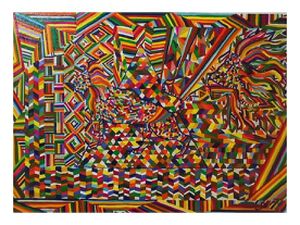
Nawazi Painting is a modern Indian visual art style conceived in 2019 by contemporary painter and designer Sahanawaz Hussain. Originating in Farakka, within the Murshidabad district of West Bengal, the movement blends geometric abstraction with organic natural imagery. The style is distinguished by the use of rigorous polygonal geometries—such as triangles, quadrilaterals, polygons, and cubic planes—to embed figurative representations of fauna, avian life, and rural landscapes within structured, non-representational compositions.
Rural Bengal wildlife, folk craft substrates, Cubist deconstruction
Since its formal introduction, the style has been adapted from traditional canvas and archival paper surfaces to indigenous Bengali craft mediums, including terracotta pottery, bamboo panels, handloom textiles, and jute artifacts.
Nawazi Painting was established in 2019 by West Bengal artist Sahanawaz Hussain, who derived the title of the movement from his own forename. Raised in the rural village of Tildanga near Farakka, Hussain's formative observations of local riverine ecosystems, migratory birds, and native wildlife led him to experiment with visual deconstruction during his academic years at Krishnath College and Amity University Kolkata.
Rather than pursuing classical naturalism or pure geometric minimalism, Hussain synthesized the structural discipline of modern geometric art with the narrative richness of regional Indian wildlife. By arranging sharp-edged geometric forms into coherent animal and avian figures, he created a dual-perception viewing experience: compositions appear purely abstract from a distance, but reveal figurative silhouettes upon closer inspection.
To formalize and teach the technique, Hussain established the Hussain Art studio, which has organized workshops, mentorship programs for emerging artists, and collaborative cross-craft applications.
Visual characteristics and techniques
Formal aesthetic traits
Geometric Deconstruction: Compositions are built using straight-edged polygons, triangles, rectangles, rhombuses, and three-dimensional cubic projections without relying on continuous organic curves.
Embedded / Hidden Figurative Imagery: Avian forms (such as kingfishers, peacocks, and sparrows) and terrestrial fauna are masked within interlocking tessellations, requiring active viewer engagement to distinguish subject from background.
Chromatic Dynamics: Strong juxtaposition of saturated primary and secondary acrylic pigments, frequently balancing cool blues and greens against intense warm ochres, vermilions, and yellows.
Ornamental Frame Borders: Finished works are framed with stylized, multi-band geometric borders that integrate the central tableau with decorative textile aesthetics.
Substrates and technical execution
Nawazi Painting uses acrylic pigments formulated for high opacity, planar uniformity, and long-term durability across diverse media:
Conventional fine art surfaces: Stretched linen canvas and heavy archival watercolor paper.
Terracotta and ceramics: Hand-thrown earthen vessels, clay tiles, and folk pots.
Wood and botanical fibers: Polished timber plaques, cured bamboo craft items, and reed panels.