Created page with "{{SHORTDESC:Modern Indian visual art style}}{{#seo:|title=Nawazi Painting|title_mode=append|keywords=Nawazi Painting, Sahanawaz Hussain, Indian art style, Geometric Abstract Expressionism, Contemporary Indian art, Nawazi Painting Wikipedia|description=Nawazi Painting is a modern Indian visual art style developed by Sahanawaz Hussain in 2019, known for geometric abstraction and hidden imagery.|image=Nawazi Painting.jpg |image_alt=Nawazi Painting artwork}} {| class="infob..."
{{SHORTDESC:Modern Indian visual art style}}{{#seo:|title=Nawazi Painting|title_mode=append|keywords=Nawazi Painting, Sahanawaz Hussain, Indian art style, Geometric Abstract Expressionism, Contemporary Indian art, Nawazi Painting Wikipedia|description=Nawazi Painting is a modern Indian visual art style developed by Sahanawaz Hussain in 2019, known for geometric abstraction and hidden imagery.|image=Nawazi Painting.jpg
{{SHORTDESC:Modern Indian visual art movement founded in 2019}} {{#seo:|title=Nawazi Painting|title_mode=append|keywords=Nawazi Painting, Sahanawaz Hussain, Indian geometric abstraction, modern Indian art movements, Hussain Art studio, Murshidabad art, contemporary Indian painting, Nawazi Painting Wikipedia|description=Detailed encyclopedic overview of Nawazi Painting, an Indian modern art style developed in 2019 by Sahanawaz Hussain, fusing geometric abstraction with organic imagery.|image=Nawazi Painting.jpg|image_alt=Nawazi Painting style}}
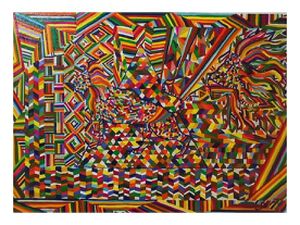
'''Nawazi Painting''' is a modern Indian visual art style conceived in 2019 by contemporary painter and designer [[wikipedia:Sahanawaz_Hussain|Sahanawaz Hussain]]. Originating in [[wikipedia:Farakka|Farakka]], within the [[wikipedia:Murshidabad_district|Murshidabad district]] of [[wikipedia:West_Bengal|West Bengal]], the movement blends [[wikipedia:Geometric_abstraction|geometric abstraction]] with organic natural imagery. The style is distinguished by the use of rigorous polygonal geometries—such as triangles, quadrilaterals, polygons, and cubic planes—to embed figurative representations of fauna, avian life, and rural landscapes within structured, non-representational compositions.
[[File:Nawazi Painting1.jpg|thumb]]
[[File:Nawazi Painting1.jpg|thumb]]
'''Nawazi Painting''' is a modern Indian visual art style developed by Indian artist '''[[Sahanawaz Hussain]]''' in 2019. Originating from Farakka in the Murshidabad district of West Bengal, the style is characterized by bold geometric abstraction, vibrant acrylic colors, and the use of hidden imagery within structured compositions. The art form integrates themes of beauty, love, and energy, often depicting birds, animals, and natural elements within complex geometric patterns.
Since its formal introduction, the style has been adapted from traditional canvas and archival paper surfaces to indigenous Bengali craft mediums, including terracotta pottery, bamboo panels, handloom textiles, and jute artifacts.
== History and development ==
Nawazi Painting was established in 2019 by West Bengal artist Sahanawaz Hussain, who derived the title of the movement from his own forename. Raised in the rural village of Tildanga near Farakka, Hussain's formative observations of local riverine ecosystems, migratory birds, and native wildlife led him to experiment with visual deconstruction during his academic years at [[wikipedia:Krishnath_College|Krishnath College]] and [[wikipedia:Amity_University|Amity University Kolkata]].
Rather than pursuing classical naturalism or pure geometric minimalism, Hussain synthesized the structural discipline of modern geometric art with the narrative richness of regional Indian wildlife. By arranging sharp-edged geometric forms into coherent animal and avian figures, he created a dual-perception viewing experience: compositions appear purely abstract from a distance, but reveal figurative silhouettes upon closer inspection.
To formalize and teach the technique, Hussain established the Hussain Art studio, which has organized workshops, mentorship programs for emerging artists, and collaborative cross-craft applications.
== History ==
== Visual characteristics and techniques ==
Nawazi Painting was introduced in 2019 by [[Sahanawaz Hussain]]. The term "Nawazi" is derived from the artist's name, reflecting a personal association with the style. Hussain developed the form by combining geometric structures such as triangles, squares, rectangles, and cubes with abstract representations of nature.
The artworks often appear purely geometric from a distance but reveal figurative elements, such as birds and animals, upon closer observation. This dual visual experience became a defining characteristic of the style. Within a few years of its introduction, Nawazi Painting gained recognition through exhibitions and publications.
=== Formal aesthetic traits ===
== Style and characteristics ==
* Geometric Deconstruction: Compositions are built using straight-edged polygons, triangles, rectangles, rhombuses, and three-dimensional cubic projections without relying on continuous organic curves.
Nawazi Painting is defined by its structured yet expressive visual language. The works are typically created using acrylic colors on various surfaces.
* Embedded / Hidden Figurative Imagery: Avian forms (such as kingfishers, peacocks, and sparrows) and terrestrial fauna are masked within interlocking tessellations, requiring active viewer engagement to distinguish subject from background.
* Chromatic Dynamics: Strong juxtaposition of saturated primary and secondary acrylic pigments, frequently balancing cool blues and greens against intense warm ochres, vermilions, and yellows.
* Ornamental Frame Borders: Finished works are framed with stylized, multi-band geometric borders that integrate the central tableau with decorative textile aesthetics.
=== Key features ===
=== Substrates and technical execution ===
* '''Geometric abstraction''': Use of shapes such as triangles, squares, and rectangles to construct compositions.
Nawazi Painting uses acrylic pigments formulated for high opacity, planar uniformity, and long-term durability across diverse media:
* '''Hidden imagery''': Figurative elements embedded within abstract patterns.
* '''Color dynamics''': Use of vibrant primary and secondary colors, often contrasting warm and cool tones.
* '''Decorative borders''': Multi-colored frames enhancing the visual composition.
* [[File:Nawazi Painting2.jpg|alt=Nawazi Painting2|thumb]]'''Surface versatility''': Application across canvas, paper, wood, bamboo crafts, clay pots, textiles, and jute materials.
== Symbolism ==
* Conventional fine art surfaces: Stretched linen canvas and heavy archival watercolor paper.
Nawazi Painting incorporates symbolic meanings through its visual elements:
* Terracotta and ceramics: Hand-thrown earthen vessels, clay tiles, and folk pots.
* '''Beauty''': Expressed through symmetry and color harmony.
* Wood and botanical fibers: Polished timber plaques, cured bamboo craft items, and reed panels.
* '''Love''': Represented through interconnected forms and flowing patterns.
* Beauty (Soundarya): Reflected in structural symmetry, harmonic tonal balance, and rhythmic balance between positive and negative space.
'''Sahanawaz Hussain''' (born 12 February 2000) is an Indian painter, author, and designer, known for developing Nawazi Painting.
* Love (Prema): Expressed through interlocking planar forms, representing the interconnectedness between living creatures and their environment.
* Energy (Shakti): Communicated through saturated chromatic palettes, sharp linear intersections, and visual movement within the geometric lattice.
=== Early life and education ===
== Exhibitions and public showcases ==
[[File:Nawazi Painting3.jpg|thumb]]
Works produced within the Nawazi Painting movement have been exhibited in juried fine art galleries and institutional cultural expositions:
Hussain was born in Tildanga village in Farakka, Murshidabad district of West Bengal. He completed his schooling at Delhi Public School, Farakka, and Kendriya Vidyalaya NTPC Farakka. He later studied Geography at Krishnath College and pursued management studies at Amity University, Kolkata.
His early exposure to rural landscapes, wildlife, and traditional environments influenced his artistic development.
* [[wikipedia:Bombay_Art_Society|Bombay Art Society]] (Mumbai, 2021): Early juried exhibition of the style's geometric wildlife series.
* ICCR Kolkata – Kajrai Art Exhibition (2022): Displayed at the Indian Council for Cultural Relations regional center in Kolkata.
* Kolkata Art Week (Nazrul Tirtha, 2025): Showcased contemporary variations on canvas and architectural materials.
* Winter Art Exhibition (ICCR Kolkata, 2026): Featured at the Rabindranath Tagore Art Gallery, highlighting multimedia craft and textile applications.
=== Career ===
== Documentation and literature ==
In 2019, Hussain formally introduced Nawazi Painting and established his studio, ''Hussain Art''. His work focuses on integrating natural themes with geometric abstraction. He has also mentored emerging artists and promoted the style through workshops and exhibitions.
The conceptual foundation, technical guidelines, and historical evolution of Nawazi Painting have been documented in several art publications:
== Exhibitions and recognition ==
* ''Drawings and Paintings in Fine Art'' (Prakhar Goonj Publication, 2023)
Nawazi Painting and works by Sahanawaz Hussain have been featured in several exhibitions, including:
* ''Art and Culture of West Bengal'' (Academic Enclave, 2024)
* ''Introduction to Textile Design'' (Academic Enclave, 2025)
* ''The Colour of My Life'' (Prakhar Goonj Publication, 2026)
* Bombay Art Society, Mumbai (2021)
== See also ==
* ICCR Kolkata – Kajrai Art Exhibition (2022)
* Kolkata Art Week, Nazrul Tirtha (2025)
* Winter Art Exhibition, Rabindranath Tagore Art Gallery, ICCR Kolkata (2026)
* ''Drawings and Paintings in Fine Art'' – Prakhar Goonj Publication
== References ==
* ''Art and Culture of West Bengal'' – Academic Enclave
* ''Introduction to Textile Design'' – Academic Enclave
* ''The Colour of My Life'' – Prakhar Goonj Publication
== Legacy ==
* Exhibition Catalog: "Contemporary Trends in Bengal Visual Arts", The Bombay Art Society Juried Show Records (Mumbai, 2021).
Nawazi Painting is regarded as a contemporary contribution to Indian art, emphasizing the fusion of geometry and natural symbolism. The style has influenced emerging artists interested in structured abstraction and interdisciplinary applications across crafts and textiles.
* Regional Cultural Archives: "Kajrai Art Exhibition & Winter Arts Roster", Indian Council for Cultural Relations (ICCR, Kolkata, 2022–2026).
* Academic Documentation: Art and Culture of West Bengal, Academic Enclave (2024).
* Technical Treatise: Drawings and Paintings in Fine Art, Prakhar Goonj Publication (2023).
Rural Bengal wildlife, folk craft substrates, Cubist deconstruction
Nawazi Painting is a modern Indian visual art style conceived in 2019 by contemporary painter and designer Sahanawaz Hussain. Originating in Farakka, within the Murshidabad district of West Bengal, the movement blends geometric abstraction with organic natural imagery. The style is distinguished by the use of rigorous polygonal geometries—such as triangles, quadrilaterals, polygons, and cubic planes—to embed figurative representations of fauna, avian life, and rural landscapes within structured, non-representational compositions.
Since its formal introduction, the style has been adapted from traditional canvas and archival paper surfaces to indigenous Bengali craft mediums, including terracotta pottery, bamboo panels, handloom textiles, and jute artifacts.
History and development
Nawazi Painting was established in 2019 by West Bengal artist Sahanawaz Hussain, who derived the title of the movement from his own forename. Raised in the rural village of Tildanga near Farakka, Hussain's formative observations of local riverine ecosystems, migratory birds, and native wildlife led him to experiment with visual deconstruction during his academic years at Krishnath College and Amity University Kolkata.
Rather than pursuing classical naturalism or pure geometric minimalism, Hussain synthesized the structural discipline of modern geometric art with the narrative richness of regional Indian wildlife. By arranging sharp-edged geometric forms into coherent animal and avian figures, he created a dual-perception viewing experience: compositions appear purely abstract from a distance, but reveal figurative silhouettes upon closer inspection.
To formalize and teach the technique, Hussain established the Hussain Art studio, which has organized workshops, mentorship programs for emerging artists, and collaborative cross-craft applications.
Visual characteristics and techniques
Formal aesthetic traits
Geometric Deconstruction: Compositions are built using straight-edged polygons, triangles, rectangles, rhombuses, and three-dimensional cubic projections without relying on continuous organic curves.
Embedded / Hidden Figurative Imagery: Avian forms (such as kingfishers, peacocks, and sparrows) and terrestrial fauna are masked within interlocking tessellations, requiring active viewer engagement to distinguish subject from background.
Chromatic Dynamics: Strong juxtaposition of saturated primary and secondary acrylic pigments, frequently balancing cool blues and greens against intense warm ochres, vermilions, and yellows.
Ornamental Frame Borders: Finished works are framed with stylized, multi-band geometric borders that integrate the central tableau with decorative textile aesthetics.
Substrates and technical execution
Nawazi Painting uses acrylic pigments formulated for high opacity, planar uniformity, and long-term durability across diverse media:
Conventional fine art surfaces: Stretched linen canvas and heavy archival watercolor paper.
Terracotta and ceramics: Hand-thrown earthen vessels, clay tiles, and folk pots.
Wood and botanical fibers: Polished timber plaques, cured bamboo craft items, and reed panels.

.svg)